Justine Moritz
Justine Moritz is a young woman of gentle disposition and striking appearance who enters the Frankenstein household as a servant and becomes a beloved member of the family, only to be falsely accused, convicted, and executed for the murder of William Frankenstein, a crime actually committed by the monster. Her fate represents the novel's most devastating instance of injustice, as her innocence is known to Victor alone, and his silence condemns her to the scaffold. Justine's death transforms her from a minor character into a symbol of the collateral damage wrought by Victor's ambition and the monster's vengeance, and it permanently shatters the peace of the Frankenstein family.
Identity and Background
Justine Moritz was the third of four children born to Madame Moritz, a widow. Her father had favored her, but after his death her mother treated her with inexplicable cruelty. Caroline Beaufort Frankenstein, Victor's mother, observed this mistreatment and, when Justine was twelve years old, persuaded Madame Moritz to allow the girl to live with the Frankenstein family. In Geneva, where republican institutions produced "simpler and happier manners" than in the great monarchies, a servant did not mean the same degraded condition as in France or England. Justine learned the duties of a servant without sacrificing her dignity as a human being. Caroline conceived a great attachment for her and gave her an education superior to what had originally been intended. Justine repaid this kindness with profound gratitude, though she never made professions of it; her eyes revealed that she "almost adored her protectress." She paid the greatest attention to every gesture of Caroline, regarding her as the model of all excellence, and endeavored to imitate her phraseology and manners, so that even after Caroline's death she often reminded others of her. Justine was a great favorite of Victor's; he once remarked that if he were in an ill humor, one glance from Justine could dissipate it, because she looked so frank-hearted and happy.
Life in the Frankenstein Household and Later Trials
When Caroline Beaufort Frankenstein died, everyone was too absorbed in their own grief to notice Justine, who had attended her mistress during her illness with the most anxious affection. Justine herself fell very ill. One by one, her brothers and sister died, leaving her mother childless except for the neglected daughter. Madame Moritz's conscience troubled her; she began to believe the deaths of her favorites were a judgment from heaven to chastise her partiality. A Roman Catholic, she had her confessor confirm this idea. A few months after Victor's departure for Ingolstadt, Justine was called home by her repentant mother. She wept when she left the Frankenstein house. Grief had given softness and a winning mildness to her manners, which had before been remarkable for vivacity. Her mother's repentance was vacillating: sometimes she begged Justine's forgiveness, but more often she accused her of causing the deaths of her brothers and sister. Perpetual fretting threw Madame Moritz into a decline, and she died at the beginning of the winter. Justine then returned to the Frankenstein family, where Elizabeth Lavenza, who loved her tenderly, described her as very clever, gentle, and extremely pretty, with a mien and expression that continually reminded her of Caroline.
The Murder of William and Justine's Arrest
On the evening of May 7th, the Frankenstein family went for a walk in Plainpalais. William, the youngest child, ran off to hide and was not found until the next morning, when Alphonse Frankenstein discovered his body, livid and motionless, with the print of the murderer's finger on his neck. A valuable miniature portrait of Caroline, which William had been wearing, was missing. The morning after the murder, Justine was taken ill and confined to her bed for several days. During this interval, a servant examining the clothes Justine had worn on the night of the murder discovered the miniature in her pocket. The servant showed it to another, who went to a magistrate without telling the family, and Justine was apprehended. When charged, her extreme confusion of manner confirmed the suspicion in a great measure. Victor, who had seen the monster near the scene of the crime and knew him to be the murderer, was horrified to learn that Justine was accused. He insisted to his family that she was innocent, but he could not reveal the truth without appearing mad.
The Trial and Conviction
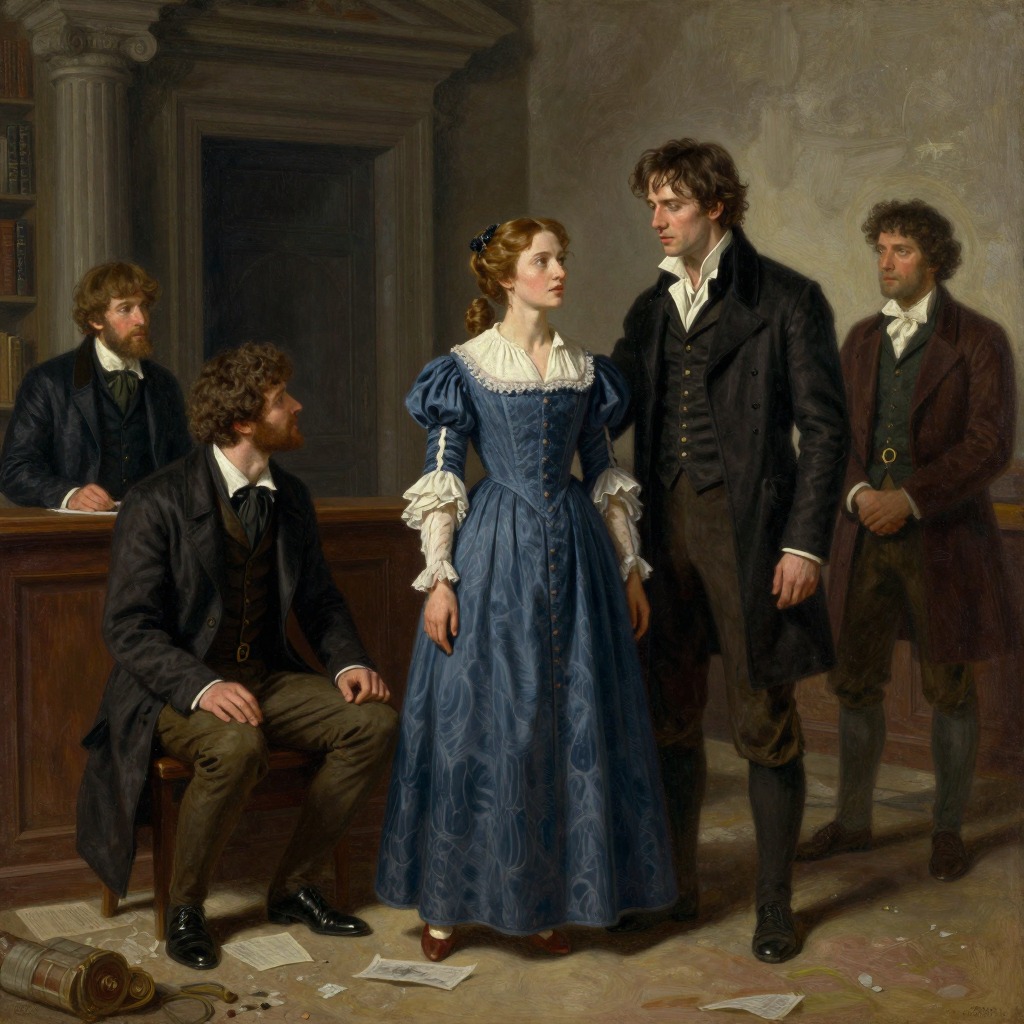
At the trial, Justine appeared calm, dressed in mourning, her countenance rendered exquisitely beautiful by the solemnity of her feelings. She seemed confident in her innocence, though her tranquillity was evidently constrained. Several strange facts combined against her. She had been out the entire night of the murder and was seen by a market-woman near the spot where the body was found, giving a confused and unintelligible answer. She returned to the house about eight o'clock and asked earnestly if anything had been heard of the child. When shown the body, she fell into violent hysterics. The miniature was produced, and Elizabeth testified that she had placed it around William's neck an hour before he was missed. A murmur of horror and indignation filled the court. In her defense, Justine explained that she had spent the evening at her aunt's house in Chene, a league from Geneva. On her return at about nine o'clock, she met a man who asked if she had seen the lost child. Alarmed, she spent several hours searching, and when the gates of Geneva were shut, she was forced to spend the night in a barn, unwilling to disturb the inhabitants. She believed she slept for a few minutes toward morning, then awoke and resumed her search. She could not account for the picture. She had no enemy on earth, she said, and could not imagine who would wantonly destroy her. Several witnesses spoke well of her character, but fear and hatred of the crime made them timorous. Elizabeth, though violently agitated, addressed the court, declaring that she had lived with Justine for years and found her the most amiable and benevolent of human creatures, that she had nursed Caroline in her last illness with the greatest affection, and that she believed in her perfect innocence. The public indignation turned against Justine with renewed violence, charging her with blackest ingratitude. The ballots were all black, and Justine was condemned. Victor, who had rushed out of the court in agony, learned that she had confessed her guilt.
The Prison Visit and Execution
Elizabeth insisted on visiting Justine in prison, and Victor accompanied her. They found Justine sitting on straw, her hands manacled, her head on her knees. She threw herself at Elizabeth's feet, weeping bitterly. Elizabeth asked why she had robbed her of her last consolation by confessing. Justine explained that she had confessed a lie, that her confessor had threatened and menaced her with excommunication and hell fire until she subscribed to a falsehood. She said she did not fear to die, that God had given her courage to endure the worst, and that she was resigned to her fate. Victor, standing in a corner of the prison, was overcome with such anguish that he groaned from his inmost soul. Justine approached him and asked if he believed her guilty; he could not answer. Elizabeth assured her that Victor was more convinced of her innocence than she herself had been. Justine expressed her gratitude and said she could die in peace now that her innocence was acknowledged by them. On the morrow, Justine died on the scaffold as a murderess. Elizabeth's heart-rending eloquence failed to move the judges, and Victor's passionate appeals were lost upon them. He realized that to proclaim the truth would only make him seem a madman and would not revoke the sentence.
Consequences and Thematic Significance
Justine's death, together with William's, marked the beginning of Victor's descent into irremediable despair. He saw himself as the true murderer, the author of unalterable evils, and lived in daily fear that the monster would commit further crimes. Elizabeth was transformed by the tragedy; she no longer saw the world as before, but felt as if she were walking on the edge of a precipice. Victor's father's health was deeply shaken. Justine's fate also illustrates the novel's critique of a justice system that condemns the innocent while the true monster remains at large. Her execution is the direct result of Victor's refusal to acknowledge his creation, and her death becomes one of the primary sources of his guilt and his eventual pursuit of the monster. The monster himself later reveals that he placed the miniature in Justine's pocket to frame her, making her death a deliberate act of cruelty designed to maximize Victor's suffering. Justine's story thus embodies the novel's central themes of injustice, the failure of human institutions, and the devastating consequences of the creator's abandonment of his creature.